
A kitesurfing camp in Nafpaktos combines several days of coaching with accommodation, gear and a schedule built around the wind.
The main difference from booking separate lessons is continuity. You ride on consecutive days, usually with the same coaching team, in the same area and with the equipment already organised.
If you organise the trip yourself, you handle the accommodation, transport, equipment, lesson times and changes in the wind forecast.
The Wind Circus camp runs in Nafpaktos, on the Gulf of Corinth, about three hours west of Athens. It is designed for complete beginners, riders who are not yet independent, and experienced riders who want focused coaching on a specific skill.
So what should you actually expect from the week, and what level do you need before you join?
This guide covers how the camp works, who it is for, the wind and spots in Nafpaktos, a typical day, no-wind days and whether the format is worth it.
Not sure whether a camp or lessons make more sense for you?
Send George from Wind Circus a WhatsApp with your level and your dates.
Message George on WhatsAppWhat is a kitesurfing camp, and how is it different from lessons?
A kitesurfing camp usually combines accommodation, coaching, equipment and several consecutive days organised around the wind. Some camps also include transport to different spots.
The main difference from individual lessons is continuity. The same coaching team can see your progress across consecutive sessions, identify what is holding you back and adjust the next session around it. Video from a session can also be reviewed afterwards.
“Some camps just give people a taste of kitesurfing. For us, the goal is different. We want people to really progress, to learn safely, and to feel supported through the whole week” Dominiki, Wind Circus Team
If you want lessons without the full trip, hourly lessons in Nafpaktos run through the season.
Why choose Nafpaktos instead of a Greek island?
The main reasons to choose Nafpaktos over an island are the learning conditions, simpler travel and the fact that you are staying in a mainland Greek town rather than a resort.
Nafpaktos sits on the north side of the Gulf of Corinth. The kite beach is close enough to walk to from the hotel, while the harbour, tavernas and town centre are nearby. It is busy in summer, but it remains a year-round Greek town rather than a purpose-built tourist resort.
“Nafpaktos offers itself to be free, but also to see where people are going, because it's small” Dominiki, Wind Circus Team
For beginners, the bigger difference is the wind. Many Aegean islands rely on the stronger Meltemi. Nafpaktos gets a local thermal wind that builds through the afternoon and is generally steadier and easier to learn in.
Getting there is also simpler: fly into Athens and drive about three hours. There are no ferries or island connections to coordinate.
Why learning on the mainland gives better value →
Do I need to know how to kitesurf before joining?
No. The camp is designed for mixed levels, including complete beginners.
A typical group is around eight to twelve people, and usually about half have never kited at all. The rest are the ones who did their ten hours somewhere and still can't go upwind, plus one or two who already ride and are working on jumps or back rolls.
Riders are grouped by level and goal once the coaching team has seen them on the water. Beginners train with beginners, while riders working on upwind riding, transitions or first jumps are grouped accordingly.
I've never kited before. Can I still join?
Yes. You don't need to know how to fly a kite, understand wind direction, own gear, or arrive fit. You need to be comfortable in the water and up for learning.
You'd start where everyone starts: setting up the gear, safety, a bit of wind theory, kite control on land, then body-dragging, then waterstarts when you're ready. And you'd be doing it alongside people at the same point, not tagging along behind riders who are already up.
The first session covers a lot at once, which is one reason consecutive days help. You repeat the same skills while they are still fresh, rather than restarting after a long gap between lessons.
“Nothing is ever the same, and I can always try and fail at my own pace” Dominiki, Wind Circus Team
How a kitesurf lesson works in Nafpaktos, step by step →
I did lessons but still can't ride upwind. Will a camp fix that?
Yes, this is one of the most common levels at the camp. You may already control the kite, body-drag and make some waterstarts, but still drift downwind or struggle to ride consistently.
The issue is often repetition rather than missing theory. Several sessions in a row, with the same spot, coaching team and equipment, make it easier to correct the same problem and practise it again the next day.
That is one of the main progression gaps the camp is designed to address.
“A lot of people are left at ten hours of kitesurfing and they still don't have the confidence to continue, but at the same time they don't want to pay for classes again. A camp is an amazing opportunity for them to progress” Dominiki, Wind Circus Team
Many riders who arrive stuck at this stage become more independent during the second half of the week, but it is not guaranteed. Progress still depends on the rider and the wind conditions.
I already ride. Is there anything in it for me?
Yes, especially if you want coaching on a specific skill such as cleaner upwind riding, transitions, first jumps or back rolls. Advanced riders are usually a smaller part of the group, but they can still receive targeted feedback across several sessions.
The value is having someone watch the same problem across multiple sessions and give you a specific correction to work on each time.
Then there's who's teaching you. George is one of the most experienced riders in Greece: freestyle, doubles, kiteloops, board-offs, over ten years teaching. Whatever you're chasing, he's done it. And he knows this gulf better than anyone. Which spot works on which wind, when it fills in, when it drops early, what size you should be on before you even rig.
The camp is mixed-level, so experienced riders share the week with beginners. Coaching groups are still organised by ability and goal on the water.
Is the wind reliable in Nafpaktos?
Yes. The local thermal typically builds through the afternoon and averages around 20 knots. Common kite sizes are 9m and 12m, with 7m used on stronger days.
Because it is a thermal wind, it tends to build progressively rather than switch on and off. On west-wind days there can be usable conditions across much of the day, allowing session times to be matched to rider level.
“Good and steady consistent wind, not too light, not too strong, just perfect. Shallow and big sandy gulf all for us, no swimmers or windsurfers, with big space for our kites outside” George, Wind Circus Team
Class times get set the day before, once George has looked at the forecast. Beginners usually go earlier when it's softer, riders who want power go when it's up.
Best time to learn kitesurfing in Greece →
Where do you kite during the camp?
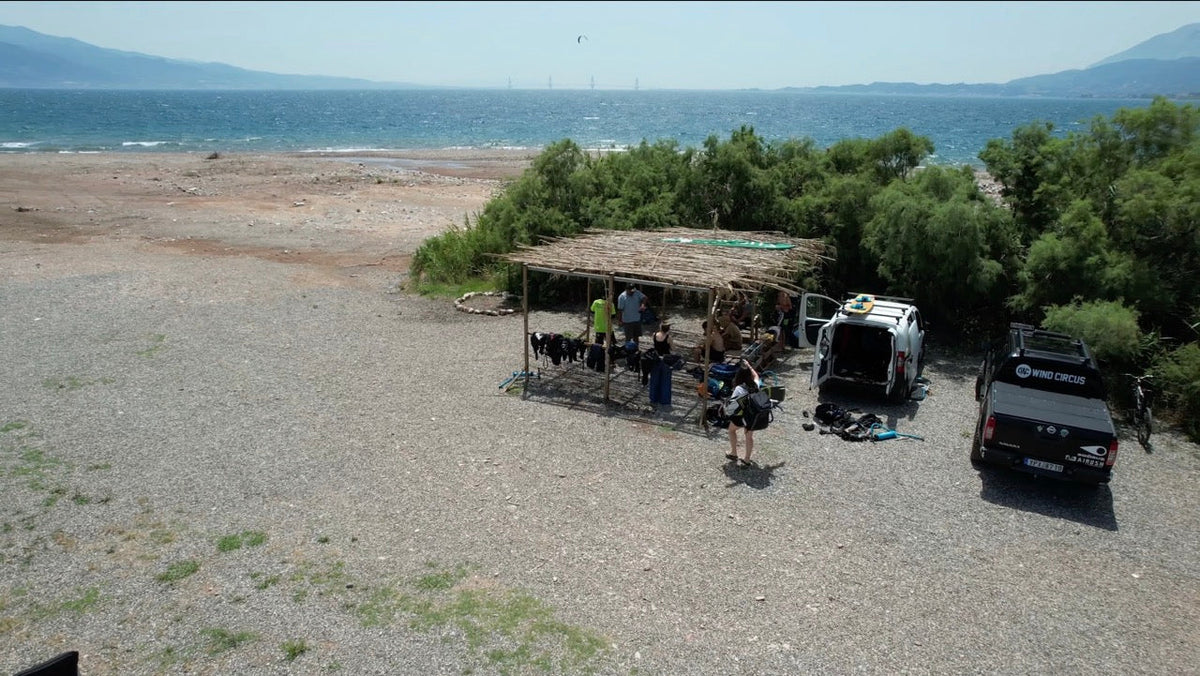
Most sessions are at Nafpaktos kite beach, within walking distance of the hotel. If another spot has better conditions, the group moves. The decision is based on the forecast, wind direction and rider levels.
| Spot | When we use it | What to expect |
|---|---|---|
| Nafpaktos kite beach | Most days, especially west wind | Shallow water, big sandy gulf, space to rig, shade and parking, five minutes from town |
| Kavourotrypa | East wind days | Shallow beach with onshore wind, much like Nafpaktos. 25 to 30 minutes by car |
| Tsimari | When the forecast makes it the better call | A change of scene, and better conditions for the group on the day |
Using more than one spot also means the camp can adapt when wind direction or conditions change.

What does a typical day at the camp look like?
There is no fixed lesson time every day. Session times are usually confirmed the day before and depend on the forecast, wind strength and your level.
Every lesson starts and ends the same way: setting the gear up, then packing it down at the end. Beginners spend the first hour on land learning the kite, the bar, the wind and the safety rules, then get in the water with a smaller bar so the kite doesn't pull too hard while your hands are learning what to do.
After the session, there is usually free time to rest. Beginners often need it because the first days of kitesurfing are physically and mentally tiring.
Evenings are mostly free. There may be a group dinner, but you are not expected to follow a fixed social schedule.
“It's important to give people independence, because it's their holiday too” Dominiki, Wind Circus Team
What a typical day learning kitesurfing in Nafpaktos looks like →
What happens on a day with no wind?
If there is no usable wind, part of the day can be used for self-rescue, safety drills, theory and equipment. Self-rescue is treated as a core skill because it directly affects how safely you can ride independently.
If the day is completely off the water, options include the castle, Psani and Gribovo beaches, nearby coastal villages such as Monastiraki, Chiliadou, Skaloma and Marathias, or Ano Chora in the mountains.
You can also use the day to rest before the next windy session.
Can I join on my own?
Yes, and most people do. Everyone's in a WhatsApp group a couple of weeks before, so you've been talking to the rest of the group before you land. Solo travellers, pairs of friends and couples all end up at the same table the first night.
What arriving alone is like, from the first evening to the room and transfer questions: Can you join a kitesurfing camp in Greece solo? →
I'm not Greek. Is the camp open to me?
Yes. The camp runs in English and regularly includes riders travelling from outside Greece.
Riders come from Greece, Cyprus, the Netherlands, Germany and further out. Some are Greeks living abroad who come back for it. Others have no connection to the place beyond wanting to kite here.
English is widely usable at the hotel, restaurants, cafés and around the kite operation. Nafpaktos is still a Greek town rather than an international resort, so Greek remains the main language around you.
Am I too old, or too unfit, to join?
Probably not. Riders in their 40s are common at the camps, and people can learn later in life. Age by itself is not the main limitation.
You do not need exceptional strength or fitness. You should be comfortable in the water, and the harness carries most of the kite's pull. The first sessions can still be tiring because you are learning several new movements at once.
George's quick answer to this: “How difficult do you think something is that you can learn in less than 12 hours?” George, Wind Circus Team
Body weight is handled by matching the kite, board and bar setup to the rider and the conditions.
Who is this kitesurfing camp not for?
Choose another destination if your priority is consistently strong, powered conditions. Nafpaktos is better suited to learning and progression in steadier, mid-range thermal wind.
It is also not a party-island experience. Nafpaktos has a busy harbour and nightlife in summer, but it is a mainland Greek town rather than a destination like Mykonos.
If you only have two or three days, individual lessons may make more sense. The main benefit of a camp comes from several consecutive days in the same place.
It is also not the right format if you want the entire camp group to be at the same riding level. The camp is mixed-level by design.
Is a kitesurfing camp actually worth the money?
Yes, if you’re comparing it with organising a full kitesurfing holiday yourself rather than just comparing lesson prices.
A camp in Nafpaktos can cost at least 30% less than putting the same week together independently. Accommodation, transport and coaching costs are shared across the group.
Prices in Nafpaktos are also lower than on many Greek islands. Kitesurfing lessons are around €70 per hour, compared with roughly €140 in some island destinations. Accommodation, food and drinks are generally cheaper too.
You’re also paying for consistency. Ten hours of coaching over consecutive days, at the same spot and with the same coach, usually leads to faster progression than spreading those ten hours across several weeks or months.
For a beginner, that can give you a much better chance of becoming an independent rider by the end of the week.
Planning a kitesurfing trip to Nafpaktos →
What else should you know before joining?
How long does it take to learn kitesurfing?
Around 10 to 12 hours is a common benchmark for reaching basic independent riding, but some people need less and others need more. A camp concentrates those hours into consecutive days instead of spreading them across a long period.
What do I need to bring?
A swimsuit, a towel, sunscreen, sunglasses, and something to wear to dinner. All the kit is provided: kite, board, bar, harness, helmet, vest, wetsuit if you need one. Nothing technical.
Is kitesurfing hard for beginners?
It is technical at first, but beginners learn it in stages. The first hours cover equipment, safety and kite control before moving into the water. Shallow water also makes early practice easier because you can stand up and reset after a fall.
What if the wind drops in the middle of my lesson?
It can happen, especially if the thermal fades earlier than forecast. The session can switch to safety, self-rescue or theory, or the remaining water time can be continued the next day.
How do I join the next camp?
Send a WhatsApp with your dates and current riding level. Dominiki and George can tell you what is available and whether the next camp fits your level. If it does not, individual lessons may be a better option.
Current dates and pricing come by message, so send your dates and George or Dominiki will tell you what's open.